Some pivots happen in careers.
Others happen in relationships.



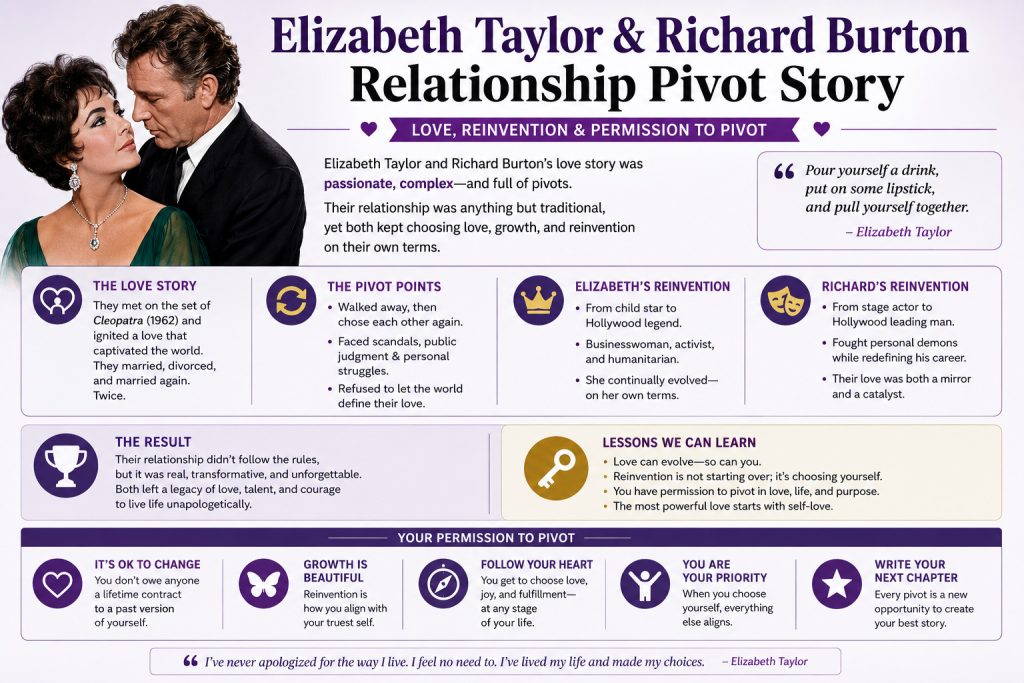
The story of Elizabeth Taylor and Richard Burton remains one of the most famous relationship pivots in modern history.
Their relationship was passionate, chaotic, magnetic, controversial, and deeply transformational.
It challenged public expectations, disrupted existing lives, and forced both individuals to confront uncomfortable truths about love, identity, desire, compatibility, and emotional intensity.
Their story reflects one of the key themes in Permission to Pivot by Tom Ferrara:
sometimes the hardest pivots are not professional. They are emotional.
Relationship pivots often require people to ask:
- Is this relationship helping me grow or keeping me stuck?
- Am I staying because it still fits or because I fear change?
- Is this passion, attachment, comfort, fear, or true alignment?
- What happens when two people evolve in different directions?
- What happens when love and compatibility are not perfectly aligned?
The Beginning: Attraction That Changed Everything
Elizabeth Taylor and Richard Burton met while filming the movie Cleopatra.
At the time, both were married to other people.
What began as attraction quickly became one of the most publicized romances in the world.
The relationship immediately created controversy.
The media obsession was intense.
Public criticism was enormous.
Religious groups condemned the affair.
The press followed them relentlessly.
Yet despite the pressure, they continued moving toward each other.
This is one of the realities of relationship pivots:
sometimes emotional truth becomes impossible to ignore once it fully surfaces.
That does not automatically make every decision healthy or easy.
But it does force honesty.
The Difference Between Comfort and Aliveness
Many people stay in relationships because:
- they are familiar
- they feel safe
- they avoid disruption
- they fear hurting others
- they fear loneliness
- they fear uncertainty
But emotional comfort and emotional aliveness are not always the same thing.
Taylor and Burton experienced a level of emotional intensity that neither seemed able to walk away from initially.
That intensity became both:
- the fuel of the relationship
and - eventually, part of its instability
This is important because relationship pivots are rarely simple.
People often confuse:
- chemistry with compatibility
- attachment with alignment
- intensity with sustainability
One of the strongest ideas in Permission to Pivot by Tom Ferrara is learning to distinguish temporary emotional intensity from deeper long-term alignment.
That applies to relationships as much as careers.
Reinvention Through Relationship
At first, Taylor and Burton appeared inseparable.
They married in 1964 and became one of the most famous celebrity couples in the world.
Together, they represented:
- glamour
- passion
- excess
- creativity
- emotional intensity
But underneath the public image were enormous challenges:
- addiction struggles
- emotional volatility
- conflict
- pressure from fame
- communication issues
- repeated instability
Their relationship illustrates something many people eventually learn:
love alone does not automatically solve incompatibility, emotional wounds, or destructive patterns.
That realization becomes the beginning of many relationship pivots.
The Pivot Nobody Wants
Eventually, Taylor and Burton divorced in 1974.
But remarkably, they remarried in 1975.
Then divorced again less than a year later.
This is why their story fascinates people decades later.
It was not simply a love story.
It was a story about emotional evolution, repeated attempts, attachment, reinvention, and the struggle between love and sustainability.
Many people experience relationship pivots that look similar emotionally, even if less publicly dramatic:
- breaking up and reconnecting
- trying again after change
- realizing chemistry alone is not enough
- recognizing repeated patterns
- struggling to separate love from dysfunction
- learning that timing matters
- understanding that two good people may still become unhealthy together
The Difference Between Growth Discomfort and Misalignment
One of the most important relationship lessons in Permission to Pivot by Tom Ferrara is learning the difference between:
- healthy relationship discomfort
and - deeper relational misalignment
This distinction matters enormously.
Every relationship experiences:
- conflict
- stress
- communication struggles
- periods of distance
- emotional difficulty
Those alone do not necessarily mean a relationship should end.
But other signs may indicate something deeper:
- repeated destructive cycles
- emotional instability without growth
- inability to repair conflict
- loss of trust
- incompatible values
- emotional exhaustion
- persistent unhappiness without progress
- recurring patterns that never truly change
Understanding this difference is one of the hardest emotional challenges people face.
Identity and Relationship Pivots
Relationship pivots are rarely just about the other person.
They are also about identity.
People begin asking:
- Who am I becoming in this relationship?
- Am I shrinking or expanding?
- Do I recognize myself anymore?
- Are we helping each other grow?
- Are we emotionally healthy together?
- Am I staying because it fits or because leaving feels terrifying?
These are deeply difficult questions.
Many people avoid them for years because relationship pivots can disrupt:
- identity
- routines
- family structures
- financial stability
- social circles
- emotional security
That fear keeps many people emotionally stuck long after clarity begins forming internally.
Emotional Intensity Is Not Always Alignment
Taylor and Burton’s relationship reminds us that intensity alone is not proof of long-term compatibility.
Some relationships feel emotionally overwhelming because:
- unresolved wounds are being activated
- attachment patterns are colliding
- emotional dependency is forming
- instability creates psychological intensity
This does not mean the relationship is meaningless.
But it does mean intensity should not automatically be mistaken for sustainability.
That distinction is critical.
Lessons People Can Learn From Elizabeth Taylor and Richard Burton
- Passion Alone Is Not Enough
Strong attraction does not automatically create long-term emotional health.
- Repeated Patterns Matter
Cycles that repeat without meaningful change often deserve honest evaluation.
- Love and Compatibility Are Not Always Identical
Two people can deeply love each other and still struggle to build stability together.
- Relationship Pivots Require Honesty
Avoiding truth usually prolongs pain.
- Emotional Growth Matters
Healthy relationships require evolution, communication, accountability, and repair.
The “What If?” Question
Almost every major relationship pivot begins with:
“What if?”
What if this no longer fits?
What if we are growing apart?
What if staying is fear, not alignment?
What if leaving is necessary for growth?
What if the relationship can evolve?
What if we are repeating the same cycle?
What if I deserve healthier communication, peace, or emotional safety?
These questions are emotionally frightening because relationship pivots affect every part of life.
But clarity rarely comes from avoidance.
Permission to Pivot
Many people already know when something feels emotionally off.
The harder part is deciding:
- whether the issue is temporary
- whether growth is possible
- whether communication can repair it
- whether boundaries are needed
- or whether a deeper pivot may eventually be necessary
That is why Permission to Pivot by Tom Ferrara resonates beyond careers alone.
The book’s themes apply powerfully to relationships because relationship pivots often involve:
- fear
- identity
- uncertainty
- attachment
- guilt
- emotional honesty
- courage
It encourages people to ask:
- Is this growth discomfort or deeper misalignment?
- Am I avoiding truth because change feels scary?
- What patterns keep repeating?
- What version of myself is this relationship creating?
- What future am I quietly trying not to see?
Elizabeth Taylor and Richard Burton’s story reminds us that some relationships profoundly change us even if they do not last forever.
And sometimes the most important relationship pivot is not about abandoning love.
It is about becoming honest enough to recognize what love alone cannot fix.
Recent Posts