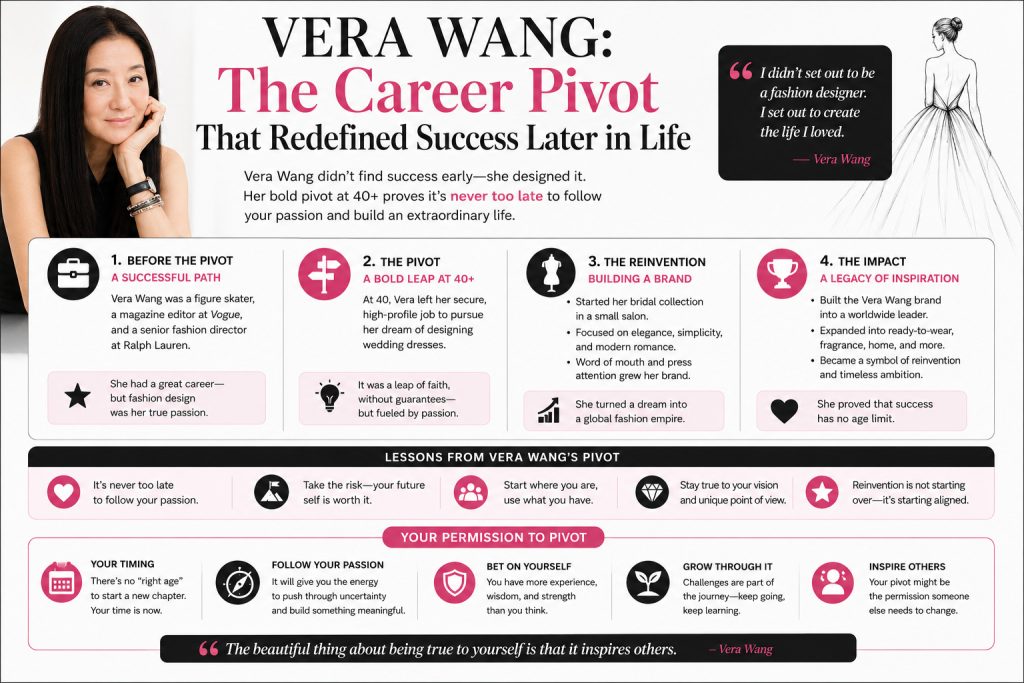
Many people believe career pivots belong to the young.
They imagine reinvention as something that happens in your twenties, maybe your thirties, before life becomes too complicated or expectations become too fixed.



But the story of Vera Wang proves something incredibly important:
some of the most meaningful pivots happen after people think their path is already decided.
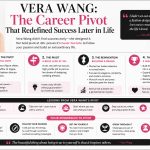
Today, Vera Wang is globally recognized as one of the most influential fashion designers in the world, especially in bridal fashion.
But her success did not begin in fashion design.
In fact, her career included multiple major pivots before she ever designed the work that made her famous.
Her story reflects one of the central messages in Permission to Pivot by Tom Ferrara:
your timeline does not define your potential, and reinvention is still possible long after people assume your direction is fixed.
The First Dream: Figure Skating
Long before fashion, Vera Wang’s first passion was figure skating.
As a teenager, she trained intensely and competed at high levels.
Like many ambitious young people, she built her identity around one future vision.
She imagined herself succeeding in skating professionally and potentially competing at the highest levels.
Then came disappointment.
Wang failed to make the U.S. Olympic figure skating team.
For many people, moments like this feel devastating because they are not simply professional setbacks.
They feel like identity collapses.
Questions emerge:
- If I am not this, who am I?
- What happens to all the years I invested?
- What if my dream no longer exists?
- What now?
This is where many career pivots quietly begin:
at the end of a version of ourselves we thought would define our future.
Pivoting Into Fashion Journalism
After skating, Vera Wang pivoted toward fashion journalism.
She joined Vogue and eventually became one of the youngest editors in the magazine’s history.
From the outside, this looked like success.
Prestige.
Influence.
Status.
Creative work.
A respected industry.
For many people, reaching this level would become the destination.
But another important lesson about pivots is this:
success does not automatically equal alignment.
A person can achieve impressive milestones and still feel a deeper pull toward something else.
Wang spent years at Vogue developing:
- taste
- creative vision
- industry knowledge
- branding instincts
- understanding of luxury and aesthetics
At the time, she likely did not realize those experiences were preparing her for a much larger pivot later.
That matters because many pivots only make sense in hindsight.
The Ralph Lauren Chapter
After leaving Vogue, Wang joined Ralph Lauren.
Again, her career appeared successful and stable.
But underneath the surface, another realization was forming.
She wanted to create, not simply edit or support other brands.
This is one of the biggest transition points professionals experience:
the movement from contributing to someone else’s vision toward building their own.
That shift is emotionally difficult because it introduces enormous uncertainty.
Questions appear:
- Am I capable of leading?
- Am I too late?
- What if I fail publicly?
- What if I leave security behind?
- What if people think I am unrealistic?
These fears keep many talented people stuck for years.
The Bridal Industry Pivot
The defining pivot in Vera Wang’s career happened when she was preparing for her own wedding.
At the time, she struggled to find a wedding dress that matched the sophistication and modern design aesthetic she envisioned.
Instead of simply accepting frustration, she recognized an opportunity.
That moment changed everything.
Wang launched her own bridal fashion business at age 40.
That detail matters enormously.
Forty.
Many people at 40 believe:
- it is too late
- their identity is already established
- starting over is too risky
- reinvention belongs to younger people
- they missed their chance
Vera Wang’s story completely destroys that narrative.
The Difference Between Discomfort and Misalignment
One of the strongest ideas in Permission to Pivot by Tom Ferrara is learning to distinguish between:
- normal growth discomfort
and - deeper misalignment
This distinction matters because not every difficult season requires reinvention.
Sometimes:
- you are learning
- you are developing mastery
- you are building resilience
- you are simply early in the process
But other times, persistent internal signals suggest something no longer fits.
Vera Wang’s earlier career chapters were not failures.
They were preparation.
But eventually, her deeper creative identity pulled her toward something more aligned.
That is a very different signal from temporary frustration.
Reinvention Often Uses Existing Strengths
One of the biggest myths about career pivots is that they require abandoning everything you already know.
Usually, the opposite is true.
Strong pivots often combine:
- past experience
- transferable skills
- accumulated perspective
- existing relationships
- personal taste
- emotional insight
Vera Wang’s earlier careers prepared her perfectly for fashion entrepreneurship.
Figure skating taught:
- discipline
- performance
- aesthetics
- resilience
Vogue taught:
- editorial taste
- fashion trends
- branding
- luxury positioning
Ralph Lauren taught:
- merchandising
- business
- product development
None of those experiences were wasted.
That is important because many professionals fear pivots will erase previous years of effort.
In reality, successful pivots often integrate earlier chapters into something more complete.
Starting Later Can Become an Advantage
Vera Wang’s age became one of her hidden advantages.
She entered entrepreneurship with:
- maturity
- perspective
- industry relationships
- confidence
- refined taste
- professional experience
Many younger founders lack those things initially.
This is one reason career pivots later in life can actually become extraordinarily powerful.
You often bring:
- emotional intelligence
- pattern recognition
- resilience
- strategic thinking
- self-awareness
- clarity about what matters
That combination can accelerate success in surprising ways.
The Emotional Side of Career Reinvention
Most pivots are not purely strategic.
They are emotional.
People wrestle with:
- fear of judgment
- fear of failure
- fear of losing status
- fear of disappointing others
- fear of financial instability
- fear of being “too late”
Vera Wang likely faced all of these.
But she moved anyway.
Not recklessly.
Not impulsively.
But intentionally.
That distinction matters.
Healthy pivots are not emotional escapes.
They are thoughtful movements toward deeper alignment.
The “What If?” Question
Almost every major career pivot begins with:
“What if?”
What if there is more for me?
What if my strongest work has not happened yet?
What if I am capable of building something larger?
What if my current role is no longer enough?
What if my frustration is trying to tell me something?
The challenge is that fear usually arrives immediately afterward.
Many people silence the question before fully exploring it.
But Wang’s story reminds us that curiosity deserves attention.
Sometimes recurring curiosity is not distraction.
Sometimes it is direction.
Lessons Professionals Can Learn From Vera Wang
- Reinvention Has No Expiration Date
Wang launched the business that made her famous at 40.
Your timeline does not define your future potential.
- Earlier Career Chapters Are Often Preparation
Your past experiences may be building transferable skills for a future pivot you cannot fully see yet.
- Success Does Not Always Equal Alignment
A respected career can still feel incomplete internally.
- Emotional Signals Matter
Persistent curiosity, frustration, or creative pull may deserve exploration rather than suppression.
- Pivots Often Build on Existing Strengths
Strong reinventions rarely erase your past.
They integrate it.
Permission to Pivot
Many people feel internal tension long before they act on it.
The harder part is deciding whether the feeling represents:
- growth discomfort
- fear
- burnout
- temporary frustration
- or a genuine signal that something deeper needs to change
That is why Permission to Pivot by Tom Ferrara resonates with professionals navigating career uncertainty and reinvention.
The book does not suggest everyone should quit or radically reinvent themselves.
Instead, it encourages people to ask better questions:
- What no longer fits?
- What keeps pulling at me repeatedly?
- Am I avoiding growth or ignoring truth?
- What strengths am I suppressing?
- What future am I quietly trying to talk myself out of?
Vera Wang’s story reminds us that some of the most meaningful pivots happen long after the world assumes your path is already set.
And sometimes the life-changing opportunity is not about becoming someone entirely different.
It is about finally becoming more fully who you already are.
Recent Posts