Sara Blakely: The Career Pivot That Turned Rejection Into a Billion-Dollar Brand
Some career pivots begin with burnout.
Others begin with frustration.



The story of Sara Blakely is one of the most powerful examples of ordinary frustration becoming extraordinary opportunity.
Today, Spanx is one of the most recognized apparel brands in the world.
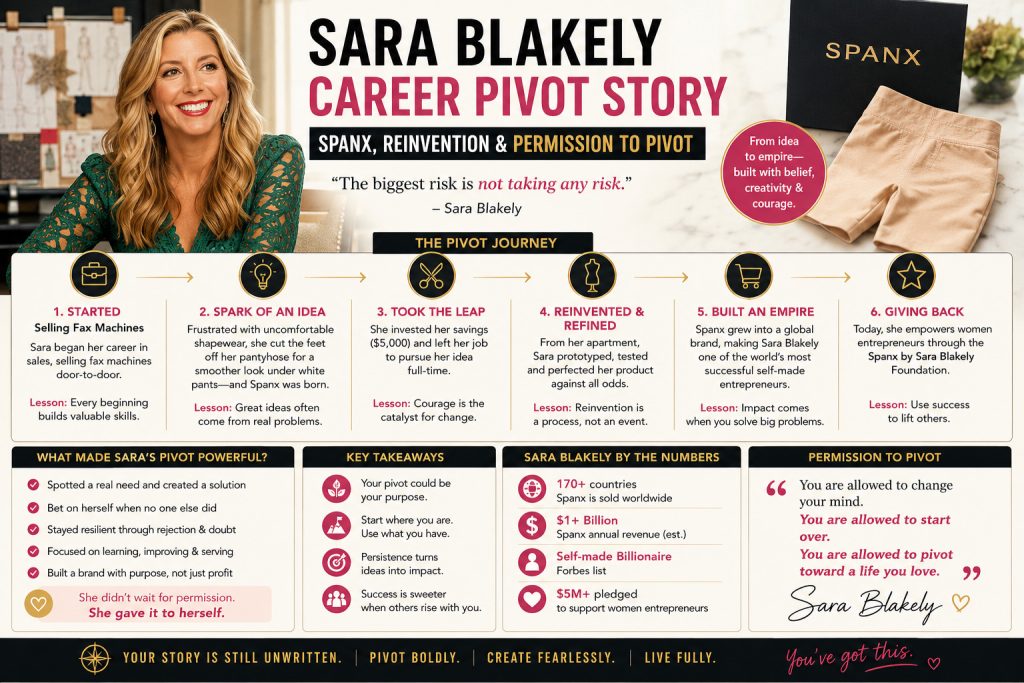
But before building a billion-dollar company, Sara Blakely was selling fax machines door-to-door.
She had no fashion background.
No major investors.
No elite business network.
No manufacturing experience.
What she did have was:
- curiosity
- resilience
- willingness to pivot
- and the ability to pay attention to a problem most people ignored
Her story reflects one of the key themes in Permission to Pivot by Tom Ferrara:
sometimes your next chapter begins when you stop dismissing the small frustrations that keep trying to get your attention.
The Early Career Path
Before becoming an entrepreneur, Sara Blakely worked various jobs while trying to figure out her direction.
She briefly considered becoming an attorney and prepared for the LSAT, but did not achieve the score she wanted.
For many people, moments like this quietly damage confidence.
Plans shift.
Identity becomes uncertain.
Self-doubt grows.
Eventually, Blakely accepted a sales job selling fax machines door-to-door for Danka.
From the outside, this was not a glamorous career path.
The work involved:
- constant rejection
- cold calling
- pressure
- uncomfortable conversations
- emotional resilience
But those years became critical preparation for her future pivot.
That matters because many pivots only make sense in hindsight.
At the time, difficult or seemingly unrelated experiences often feel disconnected from your future.
Later, you realize they were training you all along.
The Hidden Preparation
One of the biggest mistakes professionals make is assuming that only impressive jobs create valuable experience.
But Blakely’s sales career taught her:
- persistence
- communication
- confidence
- emotional resilience
- handling rejection
- persuasion
- problem-solving
Those skills later became essential when building Spanx.
This is one of the most important truths about career pivots:
very little experience is truly wasted.
Strong pivots often combine skills from earlier chapters in surprising ways.
The Problem That Sparked the Pivot
The idea for Spanx came from a simple personal frustration.
Blakely wanted to wear white pants smoothly under clothing, but disliked the visible lines and fit issues caused by traditional undergarments.
One night, she cut the feet off a pair of pantyhose to create a smoother appearance.
That small moment eventually became the foundation for a billion-dollar company.
This is important because pivots rarely begin with giant revelations.
More often, they begin with:
- recurring frustrations
- repeated curiosity
- noticing inefficiencies
- emotional reactions
- small “why doesn’t this exist?” moments
Most people ignore these signals.
Blakely paid attention to them.
The Difference Between Fantasy and Real Curiosity
Many people experience passing ideas.
But certain ideas keep returning.
They follow you.
They stay emotionally alive.
You keep thinking about them long after logic says to move on.
That persistence matters.
One of the key ideas explored in Permission to Pivot by Tom Ferrara is that recurring curiosity often deserves investigation instead of automatic dismissal.
Blakely could have easily ignored the idea.
Instead, she kept exploring it:
- researching patents
- contacting manufacturers
- developing prototypes
- refining the product
- testing reactions
That is where many pivots separate themselves from daydreams.
A true pivot usually begins moving from imagination into experimentation.
The Fear of Looking Inexperienced
One reason many people avoid pivots is fear of entering unfamiliar territory.
Blakely had no fashion-industry background.
No one was waiting for her.
No established company recruited her.
No obvious roadmap existed.
That insecurity stops many professionals before they even begin.
Questions emerge:
- Who am I to do this?
- What if people think I am unqualified?
- What if I embarrass myself?
- What if I fail publicly?
- What if I leave stability for nothing?
But pivots often require becoming a beginner again.
That is emotionally uncomfortable for almost everyone.
Building Without Validation
Another major challenge in pivots is the absence of early validation.
At first, many people did not understand the Spanx concept.
Blakely faced:
- rejection
- skepticism
- manufacturing challenges
- financial limitations
- uncertainty
But she continued moving forward.
Not because success was guaranteed.
Because she believed the problem was real and worth solving.
That distinction matters.
Healthy pivots are not reckless emotional escapes.
They are intentional movements toward possibility despite uncertainty.
The Power of Resourcefulness
One of the most remarkable aspects of Sara Blakely’s story is how resourceful she became.
She:
- wrote her own patent
- handled early product development herself
- pitched department stores directly
- personally demonstrated the product
- bootstrapped the company with limited savings
Many professionals believe they need:
- perfect credentials
- perfect timing
- perfect confidence
- perfect resources
before they can pivot successfully.
But strong pivots are often built through resourcefulness, not perfection.
The Difference Between Difficulty and Misalignment
One of the most important ideas in Permission to Pivot by Tom Ferrara is learning to distinguish between:
- growth discomfort
and - true misalignment
This distinction matters enormously.
Not every difficult situation means you should leave.
Sometimes:
- you are learning
- you are developing resilience
- you are early in the process
- you are facing necessary discomfort
But sometimes recurring frustration reveals:
- a problem worth solving
- a strength worth exploring
- an opportunity worth pursuing
- or a future direction trying to emerge
Blakely’s sales career was difficult, but it also gave her valuable preparation.
The pivot did not happen because life became hard.
It happened because a stronger vision began pulling her forward.
Career Pivots Often Begin Small
One reason many people miss pivot opportunities is because they expect dramatic certainty.
But Spanx began with:
- one frustration
- one homemade experiment
- one product idea
- one small step
That is how many meaningful pivots actually begin.
Quietly.
The future is rarely obvious at the beginning.
The Emotional Side of Reinvention
Every pivot challenges identity.
People wrestle with:
- fear of judgment
- fear of failure
- fear of looking inexperienced
- fear of losing stability
- fear of disappointing others
- fear of starting too late
Blakely experienced these fears while moving into a completely unfamiliar industry.
But she moved anyway.
Not impulsively.
Not recklessly.
But intentionally.
That difference matters.
Lessons Professionals Can Learn From Sara Blakely
- Pay Attention to Recurring Frustrations
Problems that emotionally stick with you may deserve exploration.
- Your Current Job May Be Preparing You
Skills from seemingly unrelated careers often become valuable later.
- You Do Not Need Perfect Credentials
Many pivots begin before you feel fully qualified.
- Small Experiments Matter
Big reinventions often begin with small tests.
- Resourcefulness Beats Perfection
Most successful pivots are messy at the beginning.
Permission to Pivot
Many people already feel the tension between:
- safety
and - possibility
The harder part is deciding what the signal means.
Sometimes the answer is:
- pivot fully
- experiment gradually
- build skills first
- stay and grow
- adjust the current situation
- wait intentionally
But clarity rarely comes from avoidance.
That is why Permission to Pivot by Tom Ferrara resonates with professionals navigating uncertainty, reinvention, burnout, and career change.
The book does not suggest every hard season requires dramatic reinvention.
Instead, it encourages people to ask:
- What keeps pulling at me repeatedly?
- Am I afraid or genuinely misaligned?
- What problem keeps emotionally bothering me?
- What strengths am I underusing?
- What future possibility am I trying to ignore?
Sara Blakely’s story reminds us that some of the most important career pivots begin with a simple moment most people overlook:
recognizing that a frustration may actually be an opportunity.
And sometimes the smallest honest idea becomes the beginning of an entirely new life.
Recent Posts