Colonel Sanders: The Career Pivot That Happened After Most People Would Have Given Up
Many people believe career pivots belong to the young.
They assume reinvention has an expiration date.
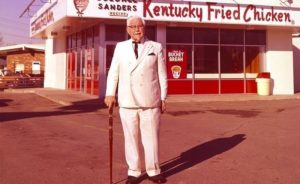
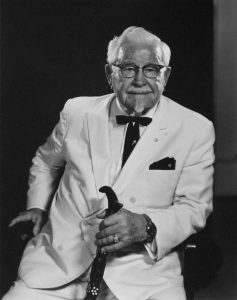
But the story of Colonel Sanders completely destroys that idea.
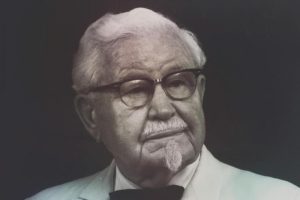
Today, Colonel Sanders is one of the most recognizable business figures in history.
His image became synonymous with KFC, one of the world’s largest restaurant brands.
But what makes his story remarkable is not just the success.
It is when the success happened.
Harland Sanders built the business that changed his life after most people would have assumed their career story was already finished.
His journey reflects one of the central ideas in Permission to Pivot by Tom Ferrara:
sometimes your most meaningful chapter begins after disappointment, failure, rejection, and years of uncertainty.
Early Career Instability
Before becoming “Colonel Sanders,” Harland Sanders worked a long list of jobs.
He was:
- a farmhand
- streetcar conductor
- railroad worker
- insurance salesman
- tire salesman
- gas station operator
His career path was anything but linear.
In fact, much of his early professional life looked unstable and inconsistent.
Many people today would probably view his résumé as chaotic.
That is important because modern professionals often panic when their path does not look perfectly organized or predictable.
But career pivots rarely happen in straight lines.
Many reinventions are built through:
- trial and error
- false starts
- setbacks
- temporary failures
- unexpected experiences
At the time, Sanders likely had no idea that these earlier struggles were building resilience, adaptability, and business instincts that would later become critical.
The Restaurant Pivot
In the 1930s, Sanders began serving food at a service station in Corbin, Kentucky.
At first, this was not a large restaurant business.
He simply noticed travelers needed food.
This matters because many pivots begin with:
- observation
- solving a practical problem
- paying attention to unmet needs
Eventually, Sanders became known for his fried chicken recipe and cooking process.
His restaurant grew in popularity, and over time he developed what would later become his famous pressure-fried chicken method and seasoning blend.
For a while, things looked promising.
But then came another major disruption.
The Pivot Nobody Wants
A new interstate highway eventually redirected traffic away from Sanders’ restaurant location.
Business collapsed.
Imagine how devastating that must have felt.
Years of work.
A successful restaurant.
A growing reputation.
Suddenly disrupted by forces outside his control.
This is one of the hardest truths about career pivots:
sometimes the pivot is forced upon you.
Industries change.
Technology shifts.
Markets evolve.
Companies restructure.
Life interrupts the plan.
Many people experience moments where the path they built no longer works the way it once did.
That moment often becomes a crossroads:
- adapt
or - stay emotionally attached to a version of the past that no longer exists
Reinvention at an Age Most People Stop
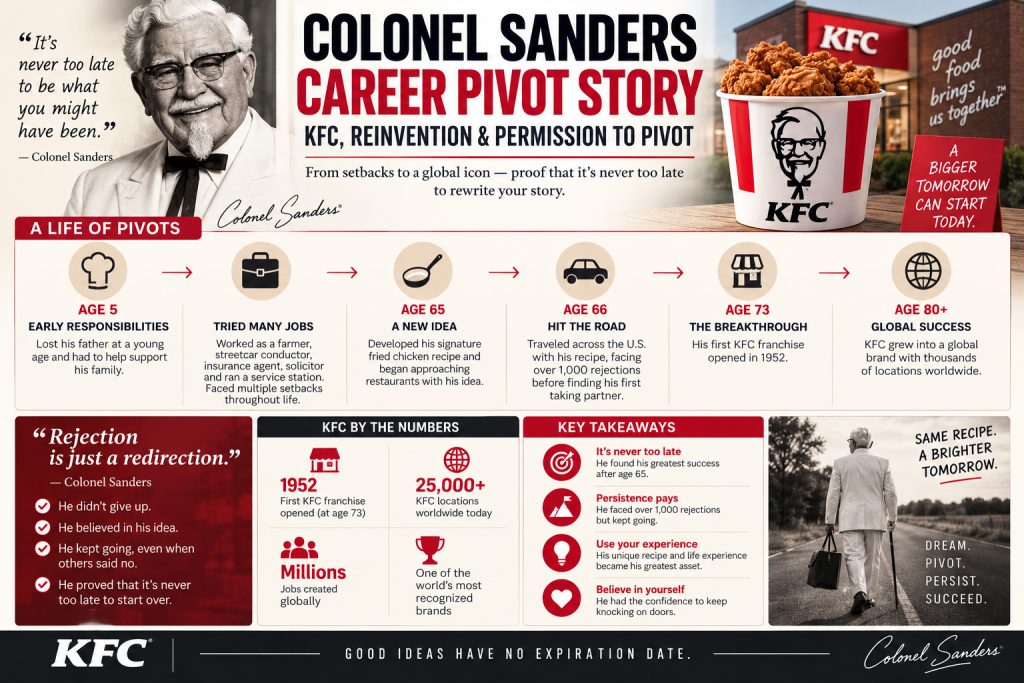
One of the most extraordinary parts of Sanders’ story is that he began building the franchise model for Kentucky Fried Chicken in his sixties.
That detail matters enormously.
Most people at that stage of life would assume:
- it is too late
- the opportunity window has closed
- reinvention belongs to younger people
- starting over is too risky
- failure would be too painful
But Sanders kept moving.
This directly connects to a major idea in Permission to Pivot by Tom Ferrara:
your age does not determine whether reinvention is still possible.
Rejection and Persistence
After losing his original restaurant business, Sanders traveled across the country attempting to convince restaurant owners to use his chicken recipe and franchise model.
The process was brutal.
He reportedly faced massive amounts of rejection.
Many owners said no.
Many dismissed the concept.
Many were uninterested.
This is where most people quit.
Not because the idea lacks potential.
Because repeated rejection becomes emotionally exhausting.
Career pivots often involve periods where:
- nobody sees the vision yet
- external validation is missing
- progress feels painfully slow
- doubt grows louder
But Sanders kept going.
That persistence eventually transformed KFC into a global business phenomenon.
The Difference Between Difficulty and Misalignment
One of the most important ideas explored in Permission to Pivot by Tom Ferrara is learning to distinguish between:
- normal difficulty
and - true misalignment
This distinction matters enormously.
Not every hard season means you should pivot.
Sometimes:
- you are learning
- you are early in the process
- you are building resilience
- you are facing temporary setbacks
But other times, external circumstances force adaptation.
Sanders did not pivot because he disliked hard work.
He pivoted because the original business model was no longer sustainable after traffic patterns changed.
That is an important difference.
Understanding whether you are facing:
- growth discomfort
or - structural misalignment
can completely change your decision-making.
Small Beginnings Can Become Massive Outcomes
One reason people dismiss pivots is because early versions often look small.
Sanders’ vision initially looked simple:
a chicken recipe and franchise model.
Few people could have imagined the scale it would eventually reach.
This is important because pivots rarely arrive looking dramatic at first.
Most begin as:
- small experiments
- repeated curiosity
- practical solutions
- side opportunities
- quiet ideas that refuse to disappear
Many professionals miss pivots because they are waiting for certainty or immediate proof.
Career Pivots Require Emotional Resilience
From the outside, Sanders’ story looks inspirational.
But emotionally, it likely involved:
- fear
- uncertainty
- embarrassment
- frustration
- exhaustion
- rejection
- financial pressure
That emotional reality exists inside almost every meaningful pivot.
People ask themselves:
- What if I fail?
- What if I look foolish?
- What if it is too late?
- What if I waste years trying?
- What if nobody believes in the idea?
These fears stop many people long before they fully explore their potential.
Lessons Professionals Can Learn From Colonel Sanders
- Reinvention Has No Age Limit
Some of the most meaningful pivots happen later in life.
- Rejection Is Often Part of the Process
Repeated rejection does not automatically mean the idea is wrong.
- Adaptation Matters
Sometimes external change forces reinvention whether you planned for it or not.
- Experience Is Never Completely Wasted
Earlier struggles often develop resilience and perspective needed later.
- Small Ideas Can Scale Enormously
Never underestimate a simple idea executed consistently over time.
The “What If?” Question
Almost every major pivot begins with:
“What if?”
What if I tried again?
What if my best chapter has not happened yet?
What if this setback is not the end?
What if the disruption is actually redirection?
What if I still have something meaningful to build?
Fear usually arrives immediately afterward.
Fear of:
- failure
- embarrassment
- judgment
- financial risk
- wasted time
- disappointment
But Sanders’ story reminds us that fear does not automatically mean stop.
Sometimes it simply means the outcome matters deeply.
Permission to Pivot
Many people silently assume their opportunity window has already passed.
That belief keeps them trapped in:
- outdated identities
- careers that no longer fit
- fear-based decisions
- emotional resignation
That is why Permission to Pivot by Tom Ferrara resonates with so many professionals navigating reinvention, uncertainty, and life transitions.
The book does not suggest every difficult season requires abandoning your path.
Instead, it encourages people to ask:
- Is this temporary difficulty or long-term misalignment?
- Am I staying because it still fits or because I am afraid?
- What possibility keeps returning to my mind?
- What future am I quietly trying to ignore?
- What if my story is not finished yet?
Colonel Sanders’ story reminds us that reinvention is not reserved for the young, the perfectly prepared, or the people with flawless careers.
Sometimes the most extraordinary pivots happen after years of struggle, rejection, and uncertainty.
And sometimes the greatest career move is simply refusing to believe your story is already over.
Recent Posts