Many people grow up believing there is one correct path to success:
- get the right education
- choose the right career
- follow the expected plan
- stay practical
- avoid risk
But some people eventually realize the path they are on may provide stability while slowly disconnecting them from who they actually are.

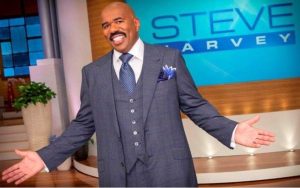

The story of Steve Harvey is one of the most powerful examples of an educational and career pivot driven by self-discovery, persistence, and the willingness to pursue a path that initially looked unstable and unrealistic.
Today, Steve Harvey is known as:
- a comedian
- television host
- producer
- author
- entrepreneur
- motivational speaker
But before fame, Harvey followed a far more traditional educational and career route.
His journey reflects one of the key themes in Permission to Pivot by Tom Ferrara:
sometimes the life you are expected to build and the life you are meant to build are not the same thing.
The Traditional Path
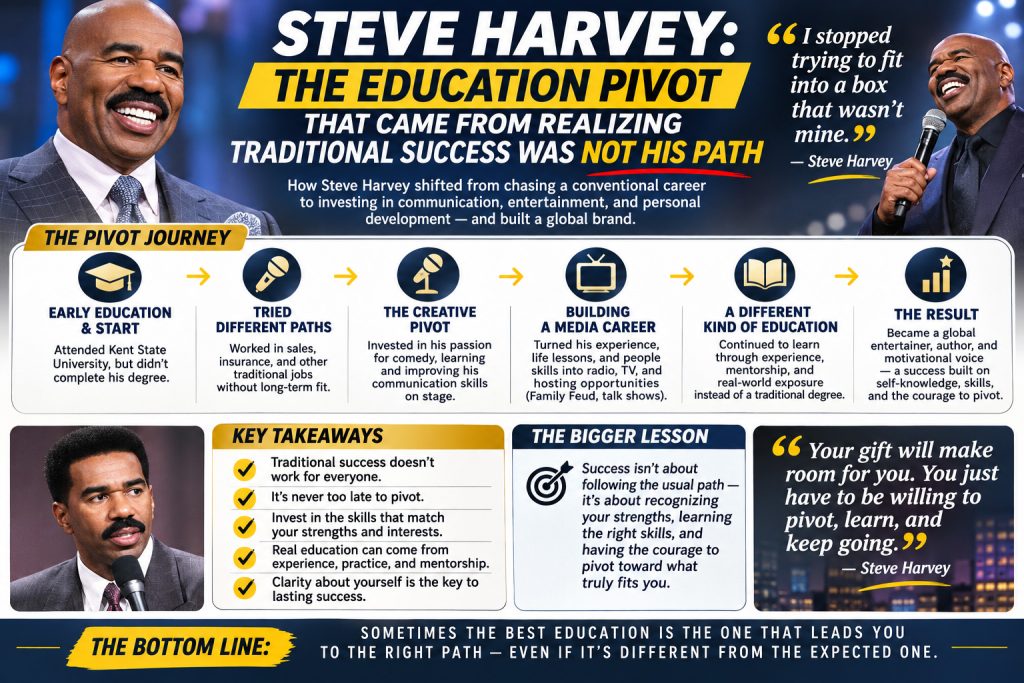
Steve Harvey attended college at Kent State University and later West Virginia University.
Like many young adults, he initially pursued what looked practical and socially acceptable.
At the time, comedy was not viewed as a stable professional future.
Most people around him likely valued:
- security
- consistency
- traditional employment
- predictable income
Eventually, Harvey worked a variety of conventional jobs, including:
- insurance sales
- carpet cleaning
- boxing promotion
- mail carrier work
From the outside, his path looked uncertain and inconsistent.
But internally, another direction kept pulling at him.
The Difference Between Stability and Alignment
One of the biggest misunderstandings about educational and career pivots is the belief that stability automatically means alignment.
A person can have:
- a respectable job
- reliable income
- external approval
- a “safe” path
while still feeling emotionally disconnected from their work.
This is one of the strongest ideas explored in Permission to Pivot by Tom Ferrara:
people often stay in paths that look successful externally while quietly feeling unfulfilled internally.
Harvey eventually realized that although he could survive in traditional jobs, they did not fully connect to his natural strengths and personality.
The Pull Toward Comedy
Comedy kept returning to him emotionally.
That matters because many pivots begin with recurring curiosity.
People often notice:
- certain activities energize them differently
- certain environments feel more alive
- certain strengths emerge naturally
- certain interests refuse to disappear
Most people dismiss these signals because they seem impractical.
Harvey eventually chose to explore comedy seriously despite enormous uncertainty.
That decision changed everything.
The Pivot Into Uncertainty
Pursuing stand-up comedy was not glamorous in the beginning.
Harvey struggled financially for years.
At one point, he reportedly lived out of his car while trying to build his comedy career.
This is one of the realities people rarely discuss openly about pivots:
many meaningful reinventions involve periods of instability before momentum appears.
At the beginning:
- outcomes are unclear
- confidence fluctuates
- money becomes stressful
- external validation is limited
- fear becomes constant
This is where many people retreat back toward safety.
Harvey kept going.
Not because success was guaranteed.
Because the path felt aligned with who he naturally was.
The Difference Between Growth Discomfort and Misalignment
One of the most important lessons in educational pivots is learning to distinguish between:
- normal growth discomfort
and - deeper misalignment
This distinction matters enormously.
Not every difficult experience means someone should change direction.
Sometimes:
- learning is uncomfortable
- growth takes time
- mastery requires persistence
- early-stage failure is normal
But other times, a person realizes:
“I can continue succeeding here, but this does not feel like who I truly am.”
That realization often becomes the beginning of a pivot.
Harvey’s comedy career involved enormous struggle, but the struggle came from pursuing growth rather than suppressing alignment.
That is a critical difference.
Reinvention Through Authentic Strengths
One reason Steve Harvey eventually became so successful is because he leaned into his authentic personality instead of trying to imitate traditional expectations.
His strengths included:
- communication
- storytelling
- humor
- emotional relatability
- presence
- improvisation
- connection with audiences
Those strengths later expanded far beyond stand-up comedy into:
- television hosting
- radio
- books
- relationship advice
- entrepreneurship
- public speaking
This is another major lesson about pivots:
your strongest future may emerge from abilities that feel most natural to you.
Educational Pivots Are Often Identity Pivots
Changing educational or career direction is emotionally difficult because identity becomes attached to expectations.
People fear:
- disappointing family
- looking irresponsible
- financial instability
- wasting education
- losing approval
- appearing inconsistent
These fears keep many people trapped in paths they no longer feel connected to.
Harvey’s story reminds us that educational pivots are rarely just about changing work.
They are about becoming honest about:
- strengths
- personality
- energy
- fulfillment
- purpose
- identity
Curiosity and Calling
One of the strongest themes in Harvey’s story is that recurring curiosity deserves attention.
Comedy was not a random distraction.
It was a repeated emotional signal.
This connects directly to Permission to Pivot by Tom Ferrara, which encourages people to stop ignoring the interests, ideas, and paths that repeatedly pull at them internally.
Sometimes curiosity is not noise.
Sometimes it is direction.
Lessons Students and Professionals Can Learn From Steve Harvey
- Stability Is Not Always Alignment
A safe path can still feel emotionally disconnected.
- Natural Strengths Matter
What feels most natural to you may eventually become your greatest professional advantage.
- Educational Pivots Are Common
Many successful people eventually move far beyond their original educational or career plans.
- Growth Often Looks Messy at First
Most meaningful pivots involve uncertainty before success appears.
- Identity Evolution Matters
You are allowed to outgrow old expectations.
The “What If?” Question
Almost every educational or career pivot begins with:
“What if?”
What if this path no longer fits?
What if my strongest gifts belong somewhere else?
What if I am capable of more than survival?
What if the thing I keep dismissing actually matters?
What if changing direction is not failure?
Fear usually arrives immediately afterward.
Fear of:
- uncertainty
- judgment
- instability
- embarrassment
- disappointing others
- starting over
But clarity rarely comes through ignoring the questions completely.
Permission to Pivot
Many people already sense when something feels disconnected.
The harder part is deciding:
- whether the discomfort is temporary
- whether fear is distorting judgment
- whether growth simply feels difficult
- or whether a deeper pivot may truly be needed
That is why Permission to Pivot by Tom Ferrara resonates with students, professionals, entrepreneurs, and anyone navigating reinvention.
The book does not encourage reckless decisions.
Instead, it encourages honest reflection:
- Am I growing or merely surviving?
- What strengths feel most alive in me?
- What future keeps pulling at my attention?
- Am I staying because it fits or because it feels safer?
- What version of myself am I afraid to become?
Steve Harvey’s story reminds us that educational and career pivots are not always about abandoning practicality.
Sometimes they are about finally becoming honest about where your natural gifts actually belong.
And sometimes the most important educational decision is giving yourself permission to pursue the path that feels most authentically you.
Recent Posts